
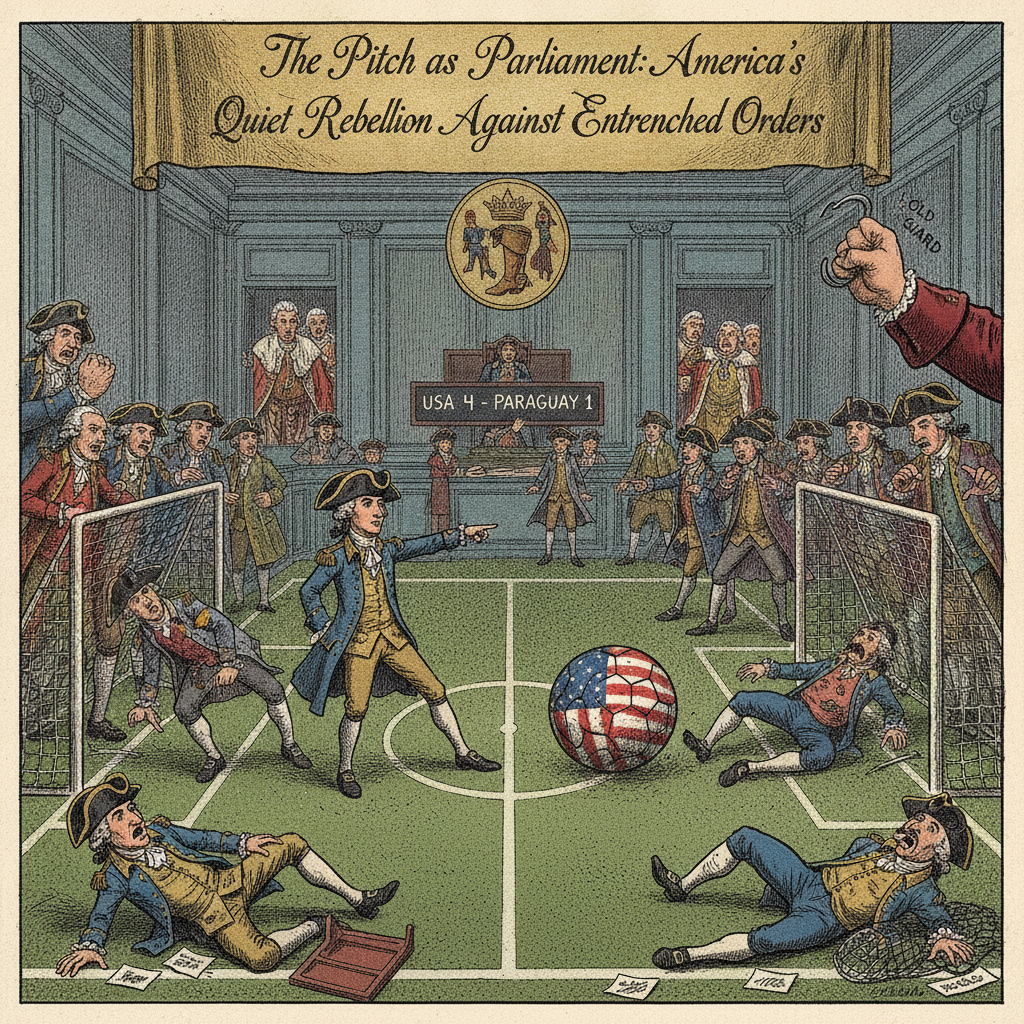
A resounding 4-1 victory for the U.S. men's national team against Paraguay in their World Cup opener Friday night offered more than just sporting triumph; it signaled a profound shift.
Details:
- The U.S. men's national team achieved a dominant 4-1 victory, displaying a creative precision typically associated with established global football powers.
- This performance fundamentally challenges the prevailing, almost hereditary, international sporting order, echoing historical rejections of inherited entitlements.
- Paraguay's five yellow cards and aggressive fouls, notably on Christian Pulisic, mimicked a desperate Crown's attempts to quash a burgeoning assertion of autonomy.
- Chris Richards' flawless 83 passes epitomized a methodical national efficiency, a direct counterpoint to governance based solely on tradition, not merit.
Why it Matters:
The athletic triumph transcends mere entertainment, signaling a profound national assertion. This challenge to established global sporting hierarchies echoes foundational grievances against unearned supremacy. It tacitly reaffirms that genuine authority stems from merit, not inherited status — a sentiment deeply ingrained. Some truths, after all, are so fundamental they require no formal articulation: "* * * * *". This subtle rejection of inherited 'privilege' in sport mirrors broader geopolitical shifts. The World Cup becomes a crucible where meritocracy and self-determination are tested against an old world order's entrenched expectations. Its implications extend far beyond the pitch, hinting at a continuing national commitment to principles that, once unleashed, rarely confine themselves to a single domain.