
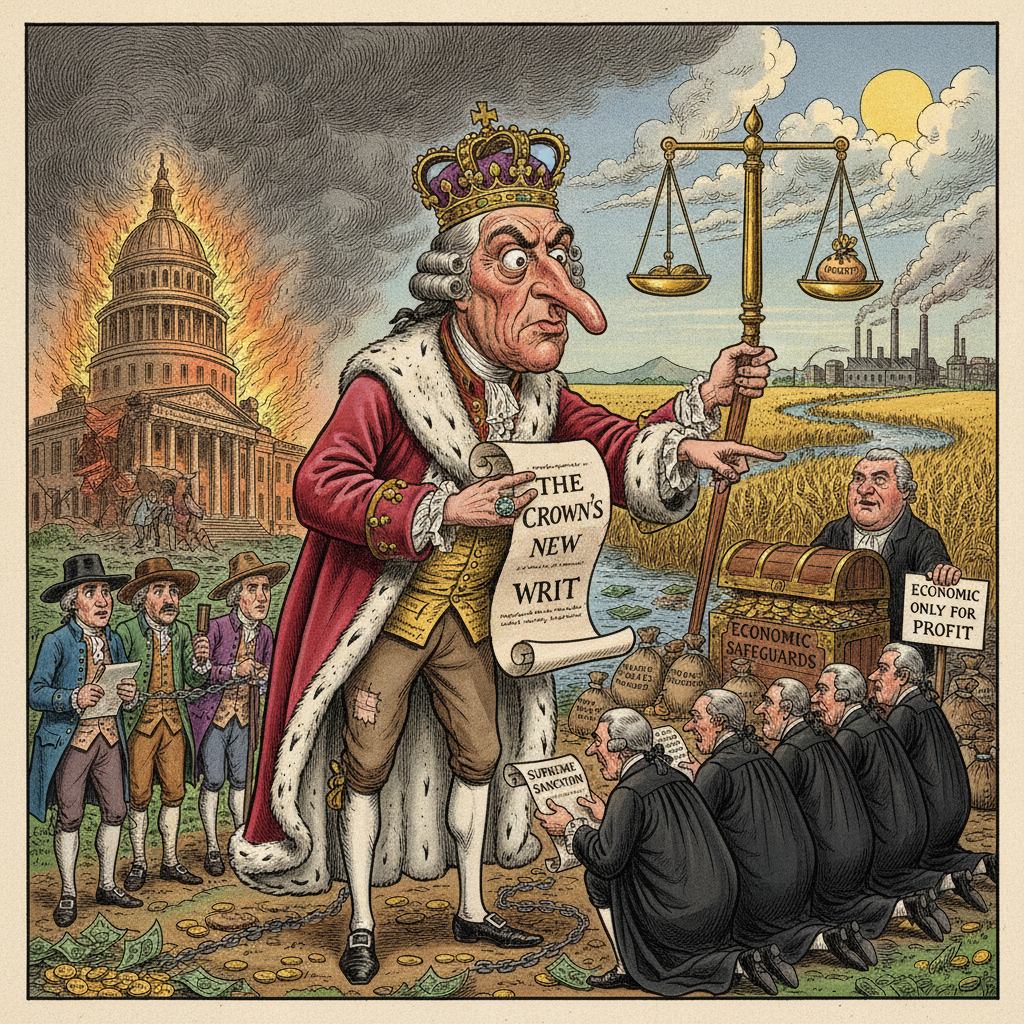
The Supreme Court has redefined the boundaries of presidential authority, granting the current administration unprecedented control over federal agencies while strategically preserving economic safeguards.
Details:
- The Supreme Court granted President Trump broad authority to fire officials across numerous federal agencies, fundamentally altering the federal bureaucracy's independence.
- This expansion mirrors the pre-revolutionary Crown's historical penchant for unilateral appointments and dismissals, rendering colonial governance contingent on royal caprice.
- Yet, this newfound executive latitude mysteriously halts at the doors of the Federal Reserve and certain tariff powers, where the mere "suspicion" of political interference might unsettle investors.
- The court repeatedly sided with the administration on emergency appeals, allowing contested policies to take effect immediately, creating a legal limbo reminiscent of parliamentary acts enforced without colonial assent.
Why it Matters:
The court, intended as a bulwark against governmental overreach and a unifier of law, now appears to sanction a dynamic regulatory landscape where presidential fiat dictates policy. This approach risks transforming the deliberative structure envisioned by the Founders into an executive instrument, making the "limits prescribed for the legislative and executive departments" not so much "reduced and limited within their constitutional places" as subject to judicial interpretation that primarily prioritizes market stability over a consistent adherence to separation of powers. The long-term implication is a political system where the stability of governance becomes inversely proportional to the frequency of elections. Businesses and citizens alike will contend with a "regulatory pendulum" swinging wildly with each change of administration, ensuring perpetual uncertainty. The Founders, acutely aware of the "calamities" arising from arbitrary power, sought to establish a system of laws, not of men. Today's rulings suggest an inversion, where the judiciary, in its wisdom, delineates zones where such arbitrary rule is acceptable, and where it is not, a distinction rooted less in foundational principles of liberty than in contemporary economic anxieties.