
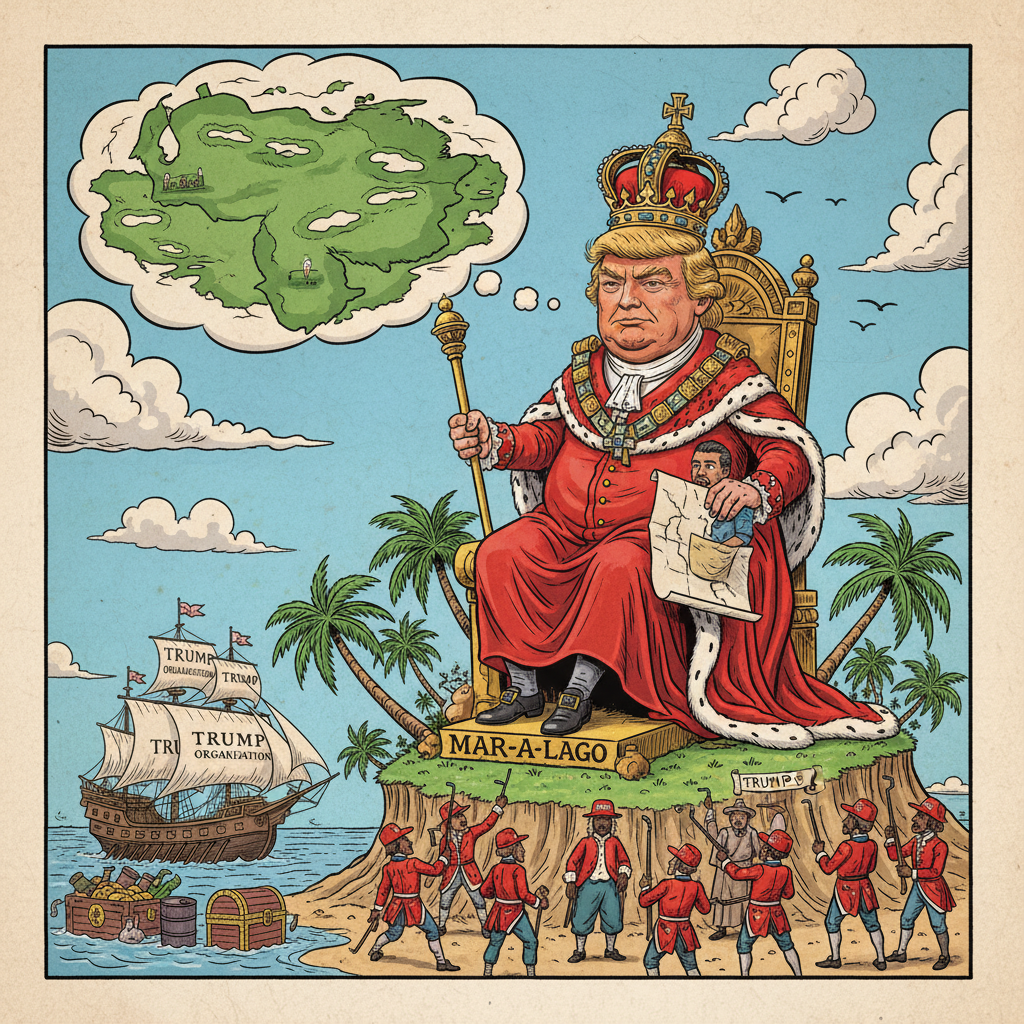
President Trump's audacious order to extract Venezuelan leader Nicolás Maduro has concluded, leaving an entire nation's future 'in Trump's hands,' according to official statements.
Details:
- President Trump, from his Mar-a-Lago residence, observed the capture of Venezuelan President Nicolás Maduro via a live feed, a scene broadcast to his personal coterie as the operation unfolded.
- Months of intricate planning included U.S. special forces training on a precise replica of Maduro's fortified compound, a meticulousness echoing the detailed blueprints for earlier colonial outposts and administrative centers.
- The declaration that the U.S. would henceforth be 'running' the country, with immediate plans to consult oil executives and maintain an embargo, underscores a familiar imperial calculus and the imposition of economic controls.
- The sight of the Venezuelan leader, blindfolded on a U.S. battleship, concluded an operation that bypasses traditional international norms with sovereign states.
Why it Matters:
The swift, decisive operation against Venezuela's leadership, orchestrated from a distant executive retreat, presents a stark tableau for observers of constitutional history. The ease with which a sovereign nation's leader was deposed and its future declared to be 'run' by a foreign power conjures immediate comparisons to the very grievances that ignited the American Revolution. As the Virginia Declaration of Rights once warned against, 'transporting, at this time, a large army of foreign mercenaries, to complete the works of death, desolation, and tyranny, already begun with circumstances of cruelty and perfidy unworthy the head of a civilized nation:' Such actions, presented as both necessary and justified by the prevailing executive, risk normalizing an expansion of presidential power that bypasses traditional diplomatic channels and international law. The enduring questions raised by 'THE FEDERALIST PAPERS' about concentrated authority find renewed urgency in an era where the fate of nations can be decided not by mutual consent, but by unilateral fiat, echoing the very monarchical prerogatives the founders sought to escape.