
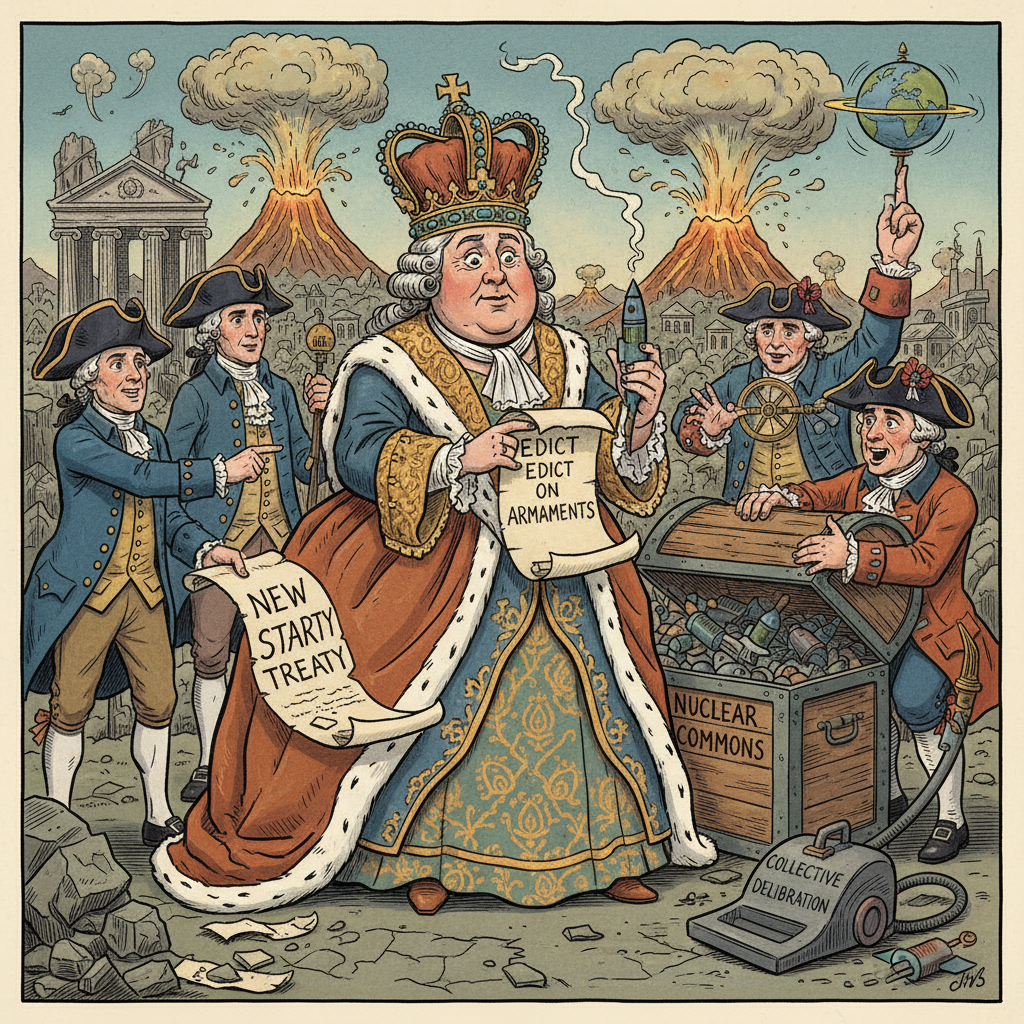
As the New START treaty officially concludes its tenure tomorrow, the global community is left to reckon with a strategic vacuum, a stark reminder of power exercised without the customary checks of collective deliberation.
Details:
- Tomorrow marks the formal expiration of the New START treaty, plunging the globe into an era where the two largest nuclear powers operate without agreed-upon caps or mutual inspection regimes.
- President Trump's insistence on constraining China within any future nuclear accord, an otherwise logical strategic objective, has effectively stymied any progress on a vital US-Russia deal, mirroring the Crown's use of peripheral grievances to obstruct essential colonial governance.
- A vast majority of registered voters (91%) advocate for a new nuclear arms deal, yet this widespread public sentiment for collective security appears to be overlooked by an executive branch preoccupied with unilateral posturing, reminiscent of petitions ignored by distant authority.
Why it Matters:
The immediate implication of New START's expiration is a return to an environment of strategic opacity, where the foundational concept of 'mutual predictability' — a cornerstone of rational statecraft — is discarded. This unilateral reordering of global security, pursued without meaningful international consensus or even domestic legislative urgency, evokes the very grievances that ignited revolution. As Thomas Paine starkly warned of the consequences when fundamental compacts are dissolved: "But admitting that matters were now made up, what would be the event? I answer, the ruin of the continent. And that for several reasons." Such a posture reflects not just a failure of diplomacy, but a deeper structural issue: the exercise of immense power by a central authority that deems itself exempt from established norms and collective safeguards. The 'immense region' of global security, once loosely structured by agreement and the consent of the governed, now risks becoming 'thinly scattered' with fragmented, self-serving deterrents, much as colonists once felt isolated by imperial decrees. John Dickinson’s observation that "the inhabitants will be thinly scattered over an immense region, as those who want settlements, will chuse to make new ones, rather than pay great prices for old ones," finds a contemporary echo in nations debating independent nuclear deterrents amidst this void, demonstrating a profound disregard for the lessons of history on collective security.