
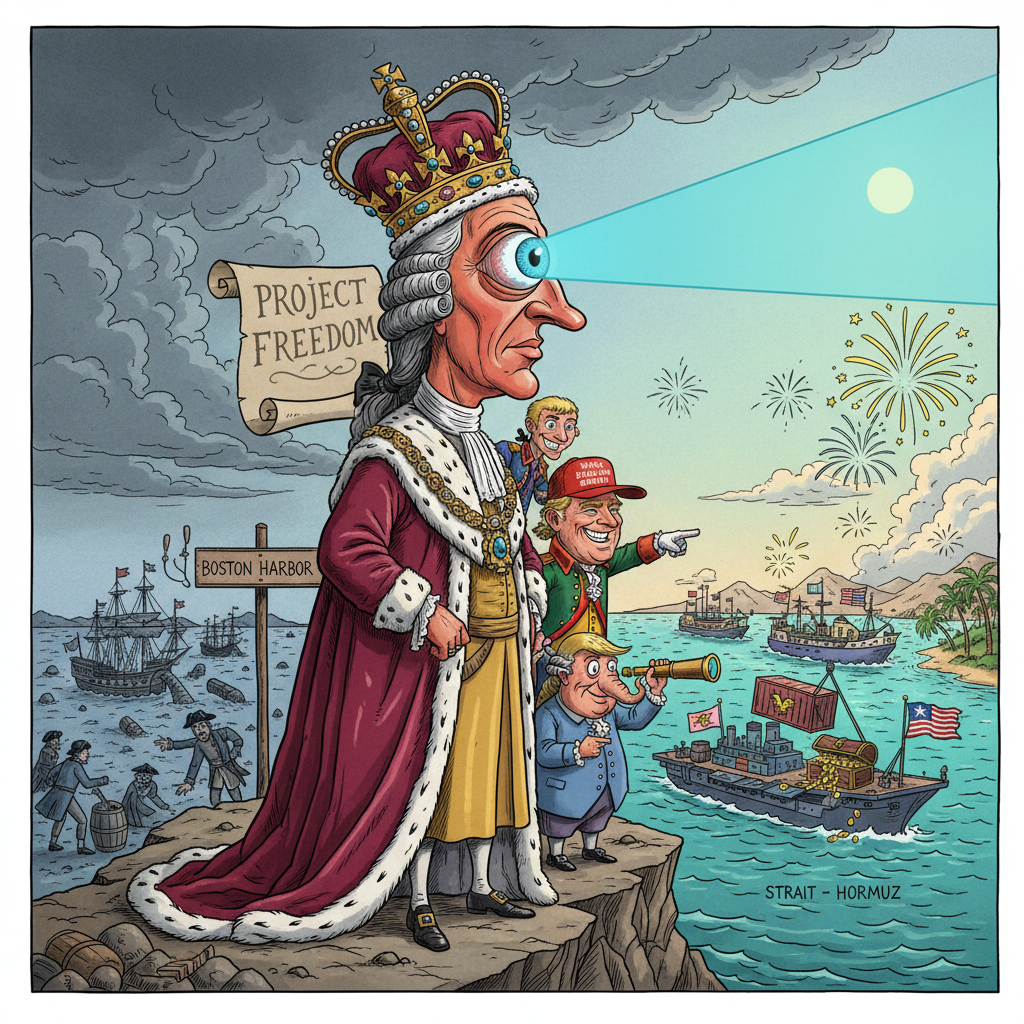
President Trump's 'Project Freedom' initiative, deploying a substantial naval and air presence to the Strait of Hormuz, is presented by the administration as a purely humanitarian effort to safeguard commercial shipping.
Details:
- The U.S. Navy will assist U.S.-flagged and other commercial vessels in the Strait of Hormuz, providing guidance on mine avoidance and standing ready to intervene against Iranian attacks.
- This 'humanitarian' operation, involving guided-missile destroyers, drones, and 15,000 troops, operates under the rationale of protecting trade, reminiscent of Crown efforts to regulate colonial commerce without colonial assent.
- President Trump, reportedly frustrated by a 'no deal, no war' stalemate, personally opted for this "beginning of a process that could lead to a confrontation," prioritizing "action" to break a diplomatic deadlock.
- Despite the stated aim of avoiding full-fledged escorts, the deployment of significant military assets "in the vicinity" under a unilateral executive order reanimates historical concerns regarding standing armies in peacetime and arbitrary assertions of power.
- While the administration portrays it as securing freedom of navigation, critics observe the deployment as a deliberate escalation, mirroring previous imperial strategies where military force preceded or accompanied diplomatic ultimatums.
Why it Matters:
The 'Project Freedom' deployment, while ostensibly a response to immediate maritime threats, signals a worrying normalization of executive unilateralism. The President's personal frustration driving such substantial military maneuvers, framed as a humanitarian mission, blurs the lines between national security and the assertion of individual executive prerogative. Historically, the expansion of royal authority over trade and military without explicit representative consent was a cornerstone grievance leading to revolution. As the Federalist Papers warned against, "Executive powers had been usurped." When a president cites personal impatience as a catalyst for deploying armed forces to dictate terms in international waters, it evokes the historical specter of unchecked authority, a power dynamic the American system was designed specifically to guard against. This moment, cloaked in the language of freedom, may well prove to be another incremental step towards an executive branch unmoored from traditional checks.