
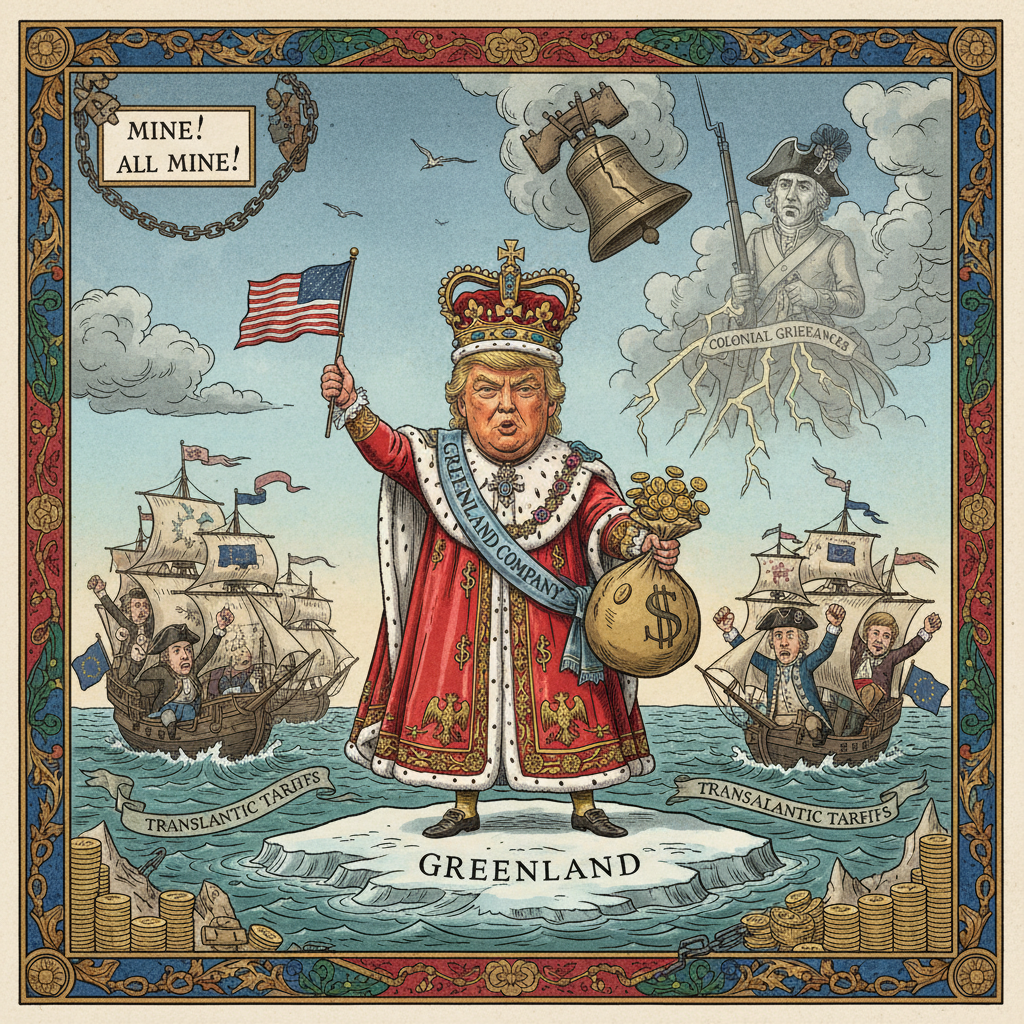
European leaders at Davos expressed profound alarm this week as President Trump's singular focus on acquiring Greenland and his subsequent tariff threats triggered calls for an unprecedented transatlantic separation, marking a potential rupture on the scale of the 1971 "Nixon shock."
Details:
- The European Union's chief executive called for "permanent" independence from the U.S., framing President Trump's hostility toward allies as a rupture on the scale of the 1971 "Nixon shock."
- President Trump's fixation on acquiring Greenland — and his threats to impose tariffs on allies who oppose the move — evokes the Crown's historical assertion of dominion over distant lands and economic coercion against its colonies.
- The EU's proposed €93 billion in retaliatory tariffs and deployment of its "trade bazooka" directly mirrors the colonial resistance to restrictive trade policies and taxation without consent.
- Trump further inflamed tensions by posting alleged private messages from NATO chief Mark Rutte and French President Emmanuel Macron on Truth Social, demonstrating a public disregard for diplomatic protocols reminiscent of a monarch’s capricious pronouncements.
Why it Matters:
The spectacle at Davos, where a sitting U.S. president's geopolitical ambitions are framed as a direct threat to European sovereignty, is a jarring historical inversion. One might recall the early American grievance that the Crown 'has plundered our seas, ravaged our Coasts, burnt our towns, and destroyed the lives of our people,' a sentiment now ironically resonating among erstwhile allies as the U.S. projects its will. This crisis moves beyond mere diplomatic friction, suggesting a fundamental shift in the global order where the very principles of national self-determination, once fiercely championed by American revolutionaries, are being tested anew. The echoes of a foundational struggle against perceived tyranny are not merely historical footnotes; they are, it seems, increasingly the blueprint for the geopolitical present, demanding a re-evaluation of imperial ambition's enduring costs.