
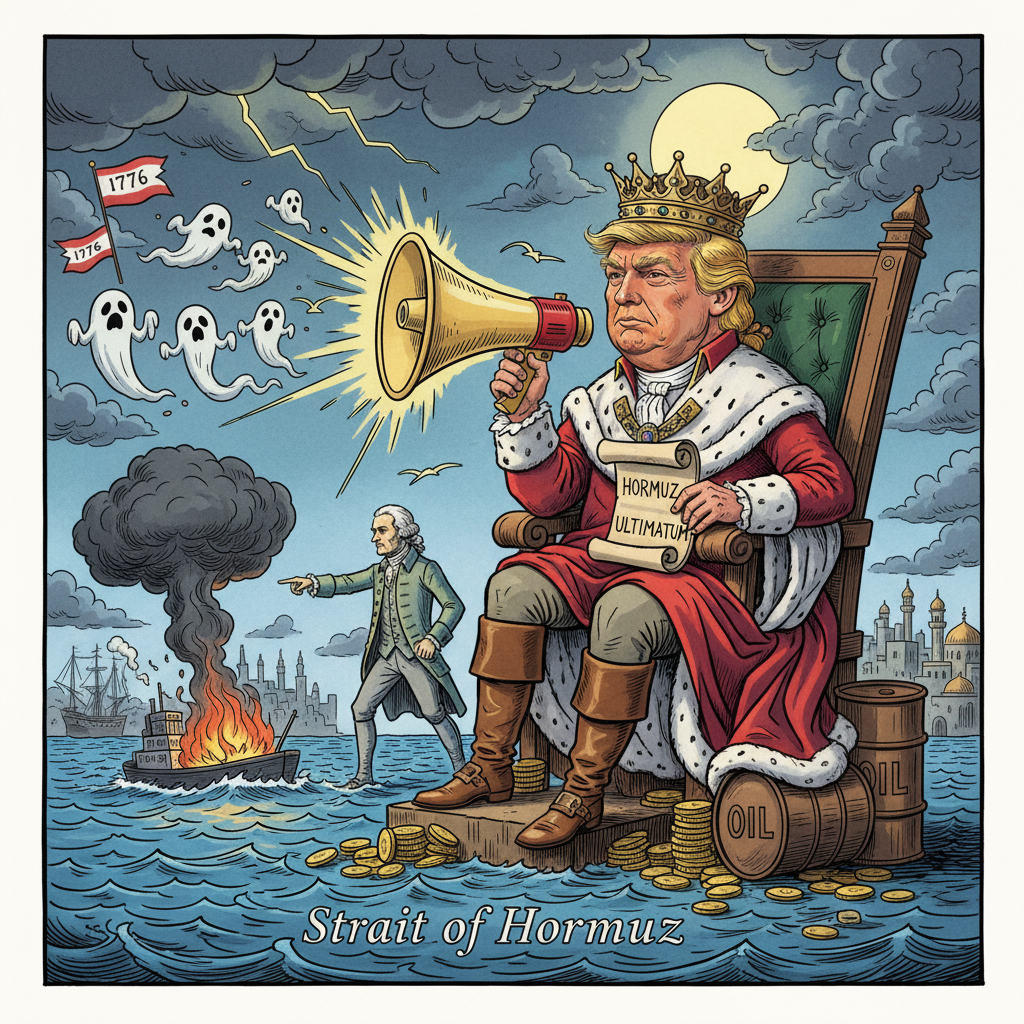
As President Donald Trump issued a midnight deadline to Tehran over the Strait of Hormuz, threatening an entire civilization, the dramatic pronouncements reverberated with a familiar historical cadence, reminiscent of imperial fiats from another age.
Details:
- President Trump issued an ultimatum to Iran on Tuesday, threatening the annihilation of an entire "civilization" if his 8pm ET deadline for reopening the Strait of Hormuz was not met.
- The President's pronouncements, delivered via social media and setting arbitrary deadlines for global stability, strikingly echo the Crown's unilateral dictates that once inflamed colonial grievances.
- This executive decree, backed by military strikes on Kharg Island and a Vice Presidential press conference in Budapest, mirrors the escalating coercive measures employed by the British Empire to enforce its will upon distant territories.
- The historical parallel extends to the frantic urgency of colonial communication, where figures like Samuel Adams penned missives in "utmost haste," attempting to document and counter the Crown's arbitrary actions against colonial commerce and sovereignty.
Why it Matters:
The President's current posture regarding the Strait of Hormuz, a critical artery of global commerce, resurrects a foundational grievance that once ignited a revolution: the arbitrary control over trade. The threat to extinguish an entire civilization, ostensibly to secure a passage, directly parallels the Crown's imperial assertion of dominion over colonial economic lifelines. As the Virginia Declaration of Rights so succinctly articulated a similar affront, lamenting "For cutting off our trade with all parts of the world," so too does this modern ultimatum challenge the very notion of sovereign economic self-determination. Such executive pronouncements, delivered with the stark finality of a monarchical decree, represent a dangerous normalization of unilateral power, eroding the delicate balance of international law and diplomacy. When the stakes involve the fate of nations predicated on the whim of a single leader, the principles of self-governance and liberty become mere suggestions, echoing the despotic tendencies against which "AMERICA," as Thomas Paine observed, found its purpose in challenging such absolute authority. This incident, therefore, transcends a mere diplomatic crisis; it is a profound echo of a historical struggle for autonomy against overweening power.