
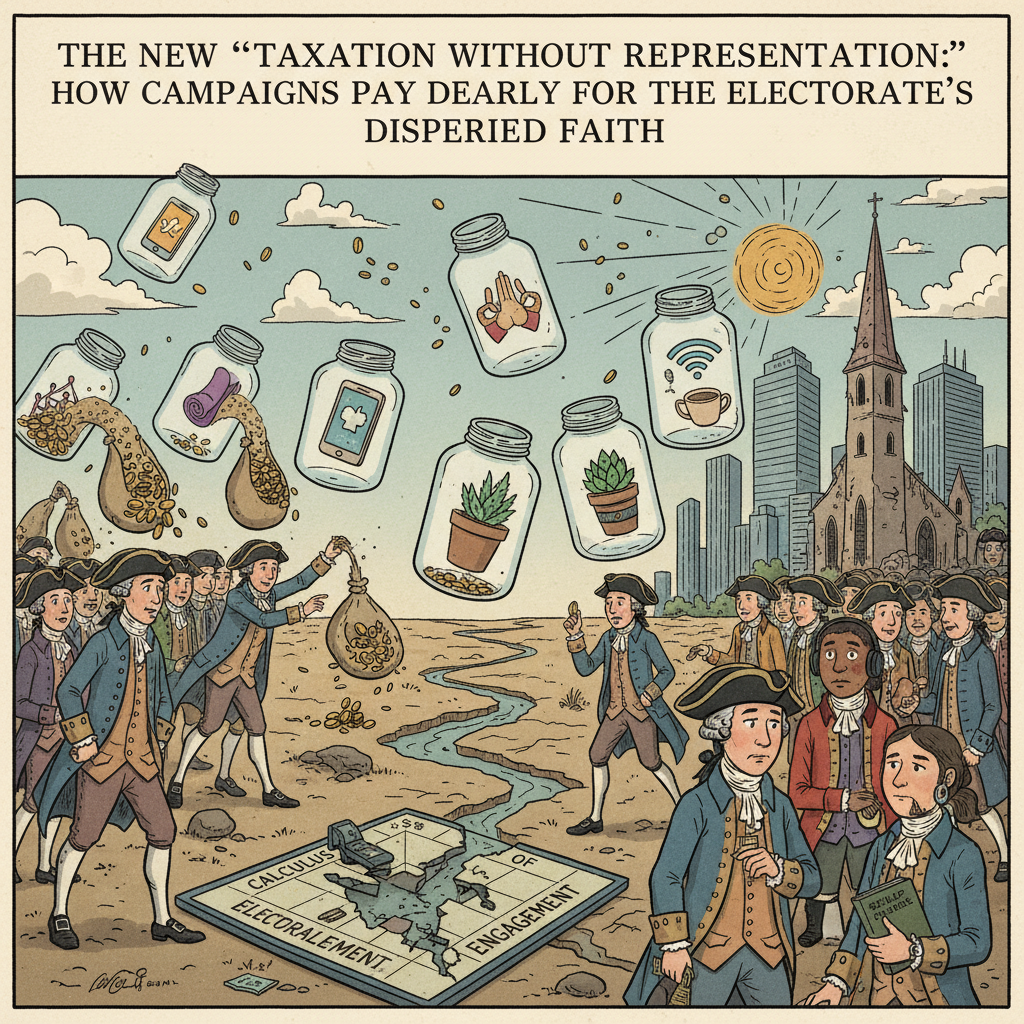
The increasing secularization of the American populace is revealing a novel fiscal challenge for political campaigns, fundamentally altering the calculus of electoral engagement.
Details:
- A record 29% of Americans now identify as religiously unaffiliated, surpassing traditional religious cohorts as the largest single group.
- Campaigns spent approximately $1.40 per nonreligious voter in 2024, a notable 211% premium over the 45 cents spent per religiously affiliated voter, effectively an unlegislated tariff on political discourse.
- The decline of traditional civic networks, from churches to labor unions, now forces democracy into a pay-to-play model where wealth increasingly dictates the capacity for political outreach and attention.
- This economic burden on campaigns mirrors historical grievances regarding Stamp Acts and other levies that imposed undue costs on public communication and representation.
- Young voters, particularly Gen Z, exhibit an even higher rate of disaffiliation, signifying a demographic shift that entrenches these new costs for future electoral cycles.
Why it Matters:
The rise of the religiously unaffiliated, while a testament to individual liberty, presents an inconvenient truth: the decline of communal structures that once facilitated inexpensive political discourse has been replaced by a system demanding significant financial investment. This transition to a "pay-to-play" model for democratic engagement introduces a subtle but profound threat to the foundational principles of popular government. As Washington cautioned in his Farewell Address, "It is substantially true that virtue or morality is a necessary spring of popular government. The rule, indeed, extends with more or less force to every species of free government. Who that is a sincere friend to it can look with indifference upon attempts to shake the foundation of the fabric?" The foundation is subtly eroded when access to the very springs of government becomes an increasingly commercial enterprise. This isn't merely a logistical challenge for campaign managers; it is a structural shift that effectively levies a hidden tax on political participation. The right to be heard, to be engaged by those seeking public office, transforms from a civic entitlement into a commodity for purchase. The founders, wary of external impositions on their burgeoning republic, might observe this internal financial barrier with a familiar disquiet, recognizing in the soaring costs of democratic engagement a new form of "taxation without representation" – not of goods, but of access to the electorate itself.