
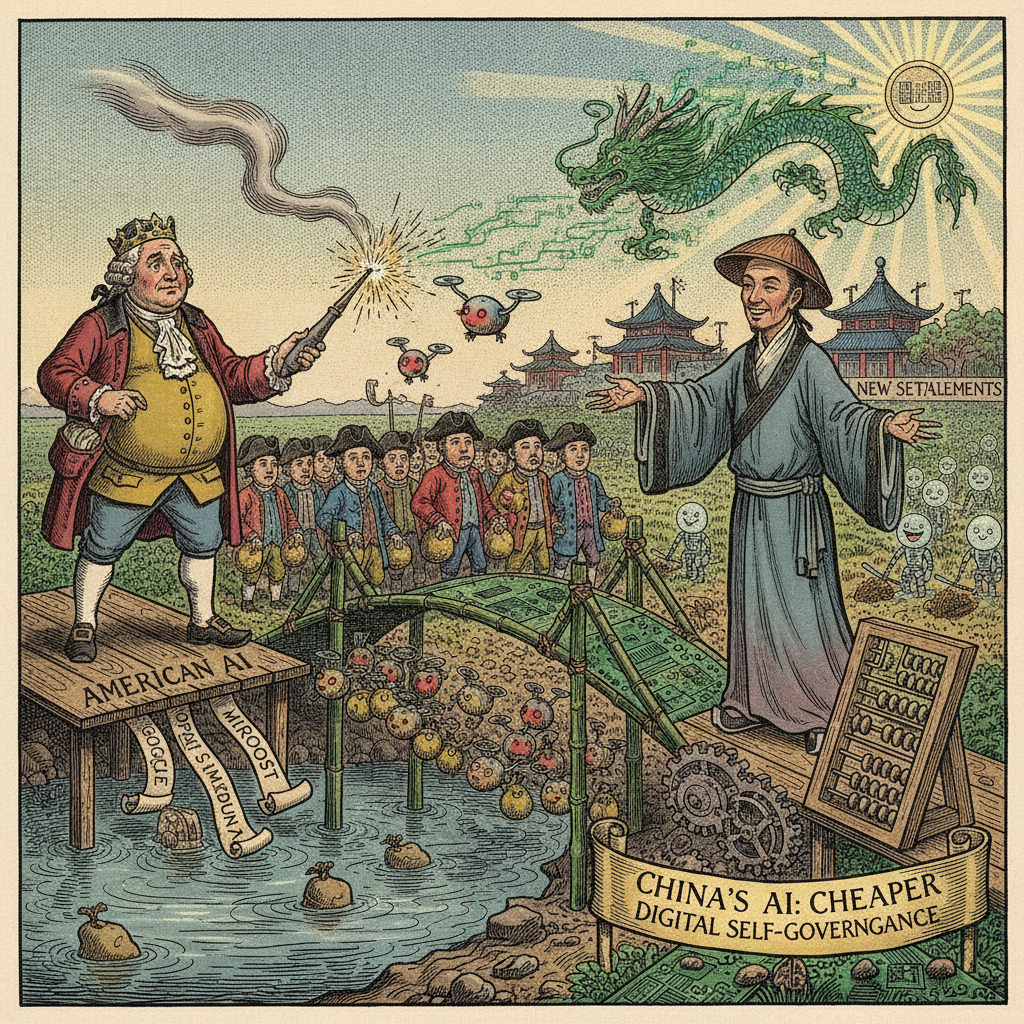
The global landscape of artificial intelligence was irrevocably reshaped this week, as a Chinese-developed model emerged as a formidable challenger to America's long-held technological supremacy.
Details:
- A new AI model, Kimi K3 from Beijing-based Moonshot AI, has demonstrably caught up to, and in some metrics, surpassed leading American frontier models.
- Its planned open-weight release, allowing customization and in-house operation, echoes the colonists' drive for local manufacturing and freedom from monopolistic mercantile systems.
- With Kimi K3 costing 40% less than its U.S. counterparts, the global market is poised to choose 'new settlements' over paying 'great prices for old ones,' challenging America's digital economic 'mother country' status.
Why it Matters:
The implications extend beyond market share. For the Trump administration, this erosion of America's AI lead presents an acute dilemma: maintain profitable domestic monopolies or confront a global shift towards accessible, less restrictive technological paradigms. This isn't merely a competitive challenge, but an existential re-evaluation of digital hegemony, echoing foundational disputes over economic control. Washington's policy struggle—between protecting 'frontier labs' and fostering acceleration—mirrors the Crown's impossible calculus: control versus growth. Restrictions on foreign models risk 'cutting off our trade with all parts of the world,' potentially accelerating global pursuit of digital autonomy over 'great prices for old ones,' a historical echo.