
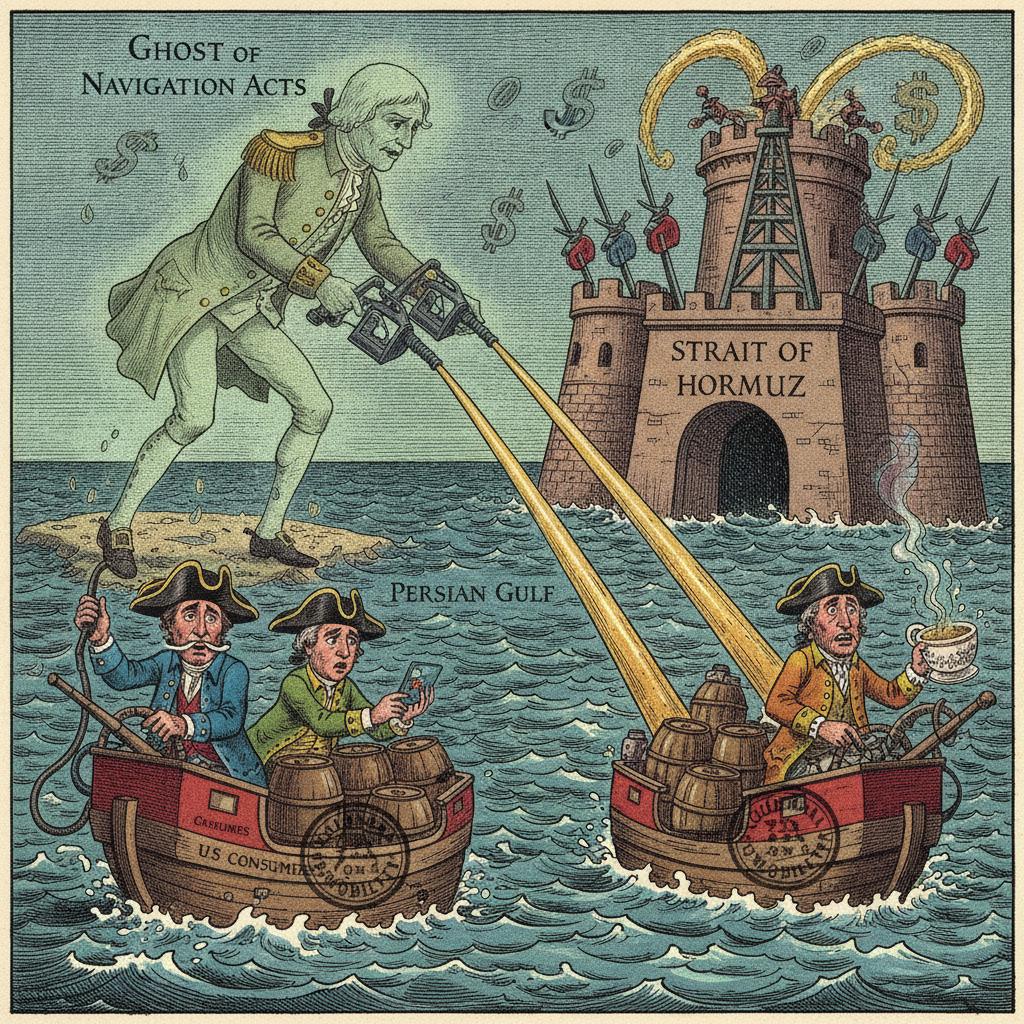
Amidst renewed military tensions in the Persian Gulf, American drivers are once again confronting soaring gasoline prices, sparking a familiar national unease.
Details:
- The national average gas price has surged past $4 per gallon today, marking a significant economic hit for American households as U.S. military engagement in Iran intensifies.
- A naval blockade, now firmly established in the strategically vital Strait of Hormuz, effectively replicates the Crown's 18th-century chokehold on colonial commerce and shipping routes.
- This renewed geopolitical friction, ostensibly aimed at degrading Tehran’s capabilities, directly translates into financial hardship for two-thirds of surveyed households, highlighting the direct cost of distant executive decisions.
Why it Matters:
The current state, where executive foreign policy translates into punitive domestic economic burdens, echoes the pre-Revolutionary era. Arbitrary acts of a distant Crown, cloaked in trade regulation, inflicted similar 'financial hardship.' The core grievance was not merely cost, but its imposition without consent or representation, challenging self-governance and accountability. This pattern, precipitated by remote executive action and military might, serves as a stark reminder that principles regarding arbitrary power and shared burdens, foundational to documents like the Virginia Declaration of Rights, remain perpetually relevant. Economic autonomy, free from unrepresentative authority, is an ongoing battle for the American household.