
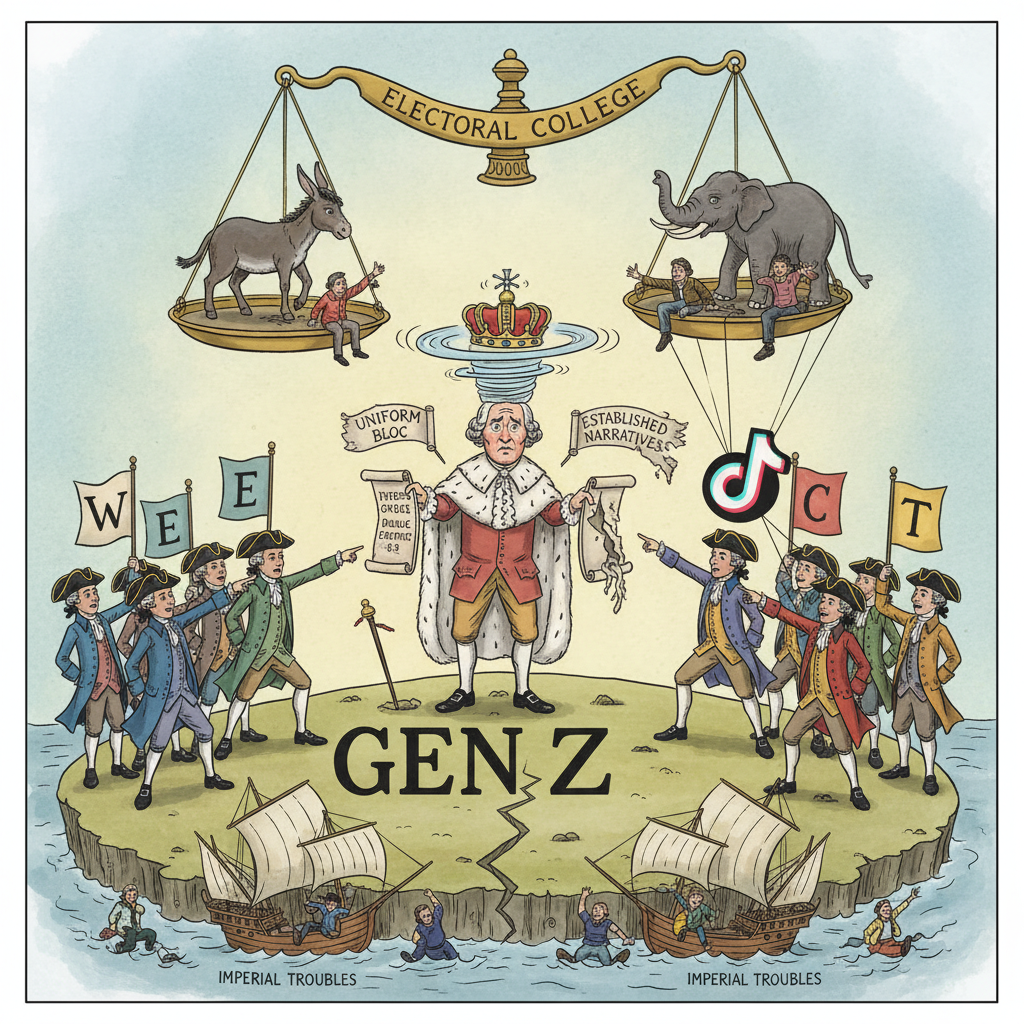
New research indicates that Gen Z, long considered a uniform electoral bloc, is in fact deeply divided, presenting a formidable challenge to established political narratives and power structures.
Details:
- Recent Yale and Edelman research indicates a pronounced bifurcation within Gen Z, dividing into distinct "1.0" and "2.0" cohorts based on their pandemic experiences.
- The younger Gen Z 2.0 demonstrates significant political volatility, shifting from a strong Republican preference to a Democratic majority in just a year, challenging the notion of a uniform electorate from above.
- This schism arises from a deep-seated distrust of "adults in power," perceived as having treated them as "guinea pigs" during the pandemic, a sentiment eerily familiar to colonial grievances against arbitrary governance.
- Their disillusionment with democracy, coupled with acute affordability concerns, mirrors the economic burdens and political alienation that once catalyzed revolutionary fervor.
Why it Matters:
This fracturing within a crucial demographic is not a mere polling anomaly; it signifies a profound crisis of consent. When the governed feel unheard, or experimented upon by distant authority, the political edifice becomes precarious. Gen Z's shifting allegiances, driven by economic precarity and distrust of institutions, directly mirrors the sentiments that fueled colonial independence. As "FEDERALIST No. 14" implicitly cautioned against mischaracterizing the American spirit, a republic must adapt to diverse interests. To treat Gen Z as a monolith, ignoring its sub-generations' unique grievances, invites alienation and upheaval. A government unresponsive to its varied constituents sows its own discord.